Metro Manila Earthquake Report, 2019
Clients who are fully subscribed to PSA’s Business Intelligence service automatically receive access to this report as a part of their subscription package. Non-subscribers may purchase the report as a standalone product at the following rates:
- USD 250 for digital access only
- USD 300 for digital access and one hard copy
- USD 50 for each additional hard copy
 |
The PSA Special Report: Metro Manila Earthquake Vulnerability Assessment is a report on the effect of a major earthquake in Metro Manila and the estimated number of casualties and cost of damages that it could incur. Discussed in detail are case studies of previous major earthquakes in the country and likely scenarios and outcomes in the aftermath of a major earthquake in the Metro Manila area, including: infrastructure damage, emergency response capacity, law and order in affected areas, as well as the possibility of regional separation as a result of collapsed buildings, elevated highways and bridges, and damaged roads and fires rendering portions of the city inaccessible from other areas. |
Executive Summary
While PSA Philippines Consultancy is not a geoscience think-tank nor has members with a geology background, the information on this report is based on open-source media and PSA’s experience on business resilience and continuity. PSA Philippines Consultancy is a business risk consultancy that has been advising safety and security in the private sector in the Philippines for approximately 20 years.
The information on this report is based on major studies covering the possibility of a major earthquake striking in the vicinity of Metro Manila, namely:
- Metro Manila Earthquake Impact Reduction Study (MMEIRS) by Japan International Cooperation Agency 2004 Report (JICA), Metropolitan Manila Development Authority (MMDA), and Philippine Institute of Volcanology and Seismology (PHIVOLCS)
- Greater Metro Manila Area Risk Assessment Project (GMMA-RAP) 2014 by Geoscience Australia and Philippine Institute of Volcanology and Seismology (PHIVOLCS)
The MMEIRS describes the effects of a magnitude 7.2 earthquake occurring on the West Valley Fault system. In the event of that earthquake, this report estimates 52,000 fatalities in Metro Manila with 34,000 resulting from the initial building collapse, and another 18,000 fatalities occurring as the result of fires breaking out across the Metro. Additionally, the study predicts 114,000 people severely injured.
The MMEIRS study estimates that 170,000 residential houses will collapse while 340,000 residential houses will be partly damaged during the quake. Fires are expected to cover approximately 1,710 hectares. Infrastructure and lifeline systems, including power grids, telecommunications networks, and water distribution infrastructure are also expected to be heavily damaged from the quake.
The GMMA-RAP findings largely confirmed the findings of the original MMEIRS study. The GMMA-RAP study presented two casualty scenarios, one in the event of a magnitude 6.5 earthquake (the most likely scenario) and the other in the event of a 7.2 magnitude earthquake (the ‘Big One’ scenario).
In a 6.5 magnitude earthquake, Metro Manila is expected to have 27,148 fatalities, with an additional 11,807 life-threatening injuries, 101,501 serious injuries, and 358,961 minor injuries. 8,169,027 meters square of buildings are expected to completely collapse, while 57,081,751 meters squared of buildings will be extensively damaged across the region. The report also estimated an economic loss of PHP 1.94 trillion (USD 38 billion).
In the 7.2 magnitude earthquake scenario, the GMMA-RAP study predicts 37,054 fatalities, in addition to 16,270 life-threatening injuries, 132,962 serious injuries, and 455,872 minor injuries. 11,052,829 meters square of buildings are expected to completely collapse, while 89,089,333 square meters of buildings will be extensively damaged across the Metro region. The study further predicts an economic loss of almost PHP 2.5 trillion (approximately USD 49 billion) in– the equivalent of 14.8% of the Philippines’ 2018 GDP.
Key Findings
Metro Manila is at risk of a 7.2 magnitude earthquake, or the ‘Big One,’ as the region sits next to the West Valley Fault System. Historical records show that the West Fault Valley System caused at least two major earthquakes within the last 1,400 years. No earthquake is known to have taken place along the fault since the 16th century. Metro Manila is also vulnerable to earthquakes from nearby and distant crustal faults, such as the Philippine Fault Zone, Lubang Fault, Casiguran Fault, and Manila Trench.
The damage in areas across Metro Manila will be largely dependent on two factors: soil composition and quality of the construction of buildings. Metro Manila’s soil composition is mixed between more vulnerable Quaternary alluvium and more structurally resilient tuff and tuffaceous sediment, and pyroclastic flows deposit adobe. In addition, the coastal regions of the Metro Manila, in particular, the northern shore of Laguna de Bay as well as the coast of Manila bay, are prone to liquefaction risks.
Meanwhile, it remains unknown how many buildings across Metro Manila are truly compliant with the structural standards set by the National Building Code. Non-compliance with national building standards remains a prevalent issue. Corruption in regulatory agencies and cost-cutting in construction materials may have compromised the structural integrity of existing buildings across the region.
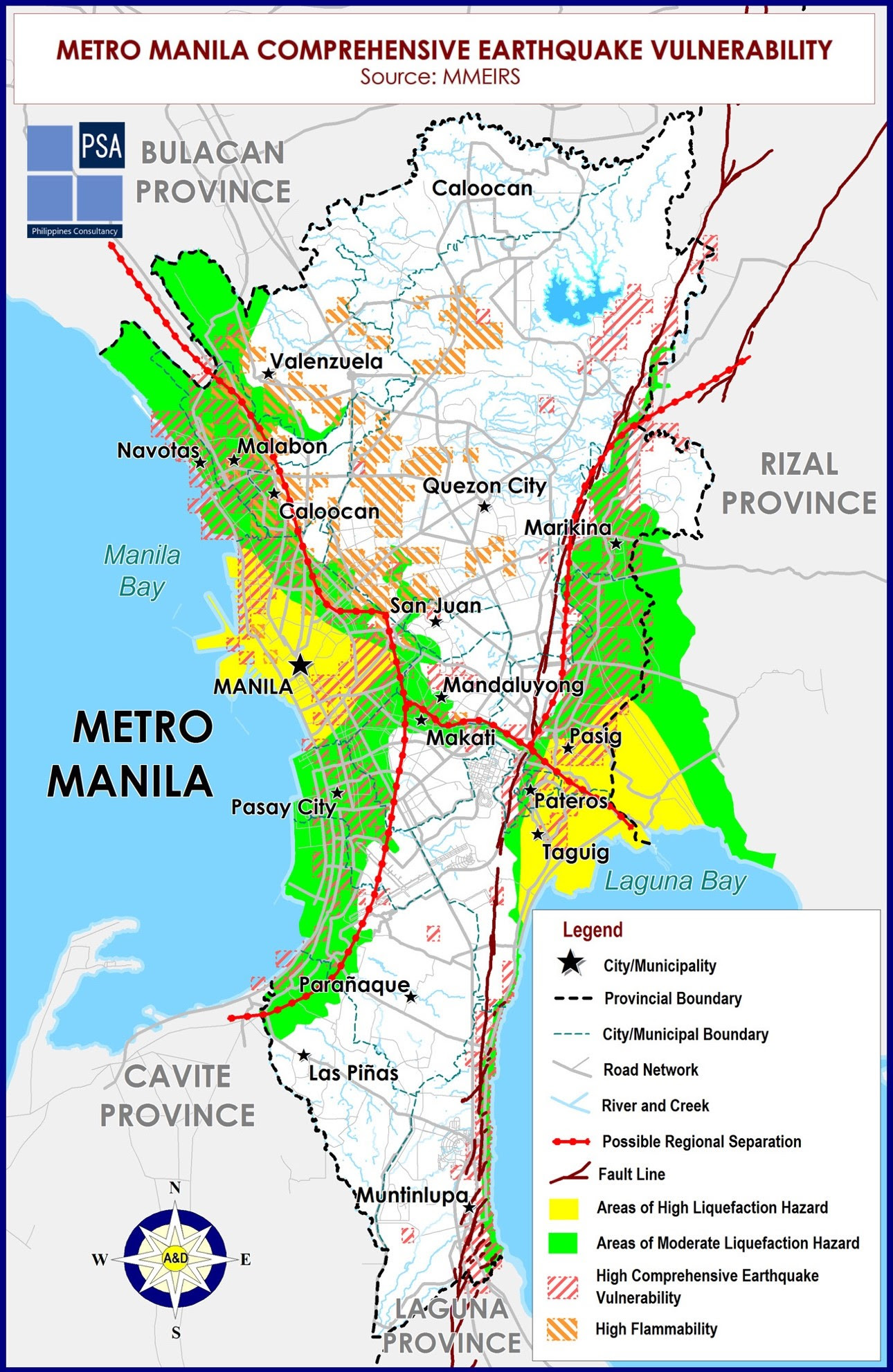
A 7.2 magnitude earthquake, or the ‘Big One,’ is expected to cause 52,000 deaths and many more injuries. Metro Manila is expected to incur around PHP 2.5 trillion (approximately USD 49 billion) in economic losses. Emergency response may be delayed due to the insufficient capacity of hospitals and firefighters to address crises in the region. In the initial hours of the aftermath, confusion and delay in the relay of information are expected. There are also few open spaces in the region to accommodate the influx of short and longer-term evacuees following a major earthquake.
Major infrastructure is expected to be severely damaged in the aftermath of the earthquake.Important roadways and bridges may collapse during the earthquake, raising the possibility of a regional separation across the metropolis. Telecommunication services, electricity, and water will most likely go down. Fires are also expected to break-out in poorer or crowded areas in Metro Manila due to bad electrical wirings and charcoal or butane burners in shanty residences.
Severe fires are expected to break out across Metro Manila, causing additional fatalities and property damage. After the initial building collapse, further damage is expected form the breakout of some 500 fires across Metro Manila, due to electrical short circuits and LPG and petroleum tank explosions. It is estimated that fires could cover as much as 1,710 hectares and result in an additional 18,000 fatalities.
Damage to water distribution pipelines is expected to limit firefighting capabilities, result in a shortage of potable water, and cause localized flooding. It is estimated that 4,000 water supply points would be cut immediately with damage to reservoirs and water purification plants causing major long-term water shortages. The metropolis’ main source of water, Angat Dam, is vulnerable to damage in the event of an earthquake as part of the facility straddles the West Valley Fault System. Damage in the dam’s slope would increase the water level of the Angat River and its tributaries and flood low lying areas in Metro Manila and Bulacan. Further, damage to pipeline networks would cut off the water supply in various areas of Metro Manila. Moreover, damage to water main pipes, conduit pipes and water reservoirs would cause major road damage. If the distribution pipes are damaged, contaminant inflows to the pipes may cause water pollution and facilitate the spread of water-borne diseases. Limited supplies of potable water would additionally result in many inhabitants resorting to drinking water from unsanitary sources, further magnifying the risks from communicable diseases. Furthermore, water pipe damage will also limit firefighting capacity.
The status of law and order in Metro Manila may broadly fall under two scenarios: In the first scenario, the government may declare martial law and looting will be widespread across the region. In the second scenario, survivors may band in groups and help each other while those who live in provinces or have connections with people in the provinces will most likely flee Metro Manila and return to their provincial hometowns. The reality may fall somewhere in between the two.
Individuals are advised to prepare for a week-long sufficiency and personal safety. As major roadways and bridges in Metro Manila may have collapsed or been damaged in the earthquake, relief efforts are expected to be delayed for at least one week. To prepare for this likelihood, individuals should prepare food and water that would last for at least one week and be familiar with best practices for before, during, and after an earthquake.
Businesses are advised to prepare for a business continuity plan in the case of a major earthquake.A business continuity plan should outline the identified external and internal vulnerabilities of the business, proposed back-up solutions to issues that may arise during a crisis, and decision implementing authority in the event of a disaster. A business continuity plan should also be simple, tested among employees in the organization, and updated from time to time.
Advice for Preparation and Response Planning
Prepare for a Week of Self-Sufficiency
Most authorities advise citizens to prepare emergency rations and other supplies good to last for 72 hours (three days). However, in the event of a ‘Big One’ earthquake striking the NCR, PSA believes that some areas of the city may not be accessible to relief operations for up to a week due to possible regional separation as well as severe damage to transpiration infrastructure. As a result, clients are advised to prepare emergency supplies for themselves, their family, and other dependents for a week – including food, water (or means of making water potable), first-aid supplies, medicine, as well as means of communication that are not reliant on the prevailing telecommunications infrastructure (which are likely to be severely damaged as well as over-utilized in the immediate aftermath of a major earthquake) such as satellite phone or radio.
Preparation As a Business
It is critical for companies to prepare a sound and viable business continuity plan to minimize business interruption and lessen the financial impact of earthquakes and other natural disasters. To start, effective business continuity plans should be mandated and endorsed by top management. With the top management’s guidance and support, organizations can devise a realistic and implementable plan that accounts for the genuine business interests of the company. With the proper commitment of management, business continuity planners can move on to the actual plan development process. The following are some core elements of business continuity planning:
Business Impact Assessment (BIA)
The BIA helps organizations understand how the business will be affected by a particular crisis. Planning managers must pinpoint specific internal and external vulnerabilities and disaster scenarios. Managers must also define the critical business processes of the organization so that there is proper focus to normalize these primary functions as quickly as possible. One common approach to conducting an effective BIA is a probability/impact matrix. For example, a terrorist attack has a low probability but a very high impact. Most routine typhoons have a very high probability of occurring but have a moderate impact. BIAs should consider all possible scenarios and the impact these scenarios have on essential functions such as communications, transportation of staff and materials and operations.
Team and Structure
Once an organization understands the impact of each potential crisis, the continuity plan development process begins. This starts with the creation of a crisis management team and the selection of a Decision Making Authority (DMA) that defines clear lines of responsibility and roles. Crisis management teams should be agile with a small group of key decision-makers. Quick decision making is critical during times of crisis.
Resources
Business continuity and crisis management are no longer a luxury, but a necessary cost of doing business. While the functions might not add to the bottom line during normal operations, the absence of the functions during times of crisis are glaring and oftentimes devastating. Managers must be proactive and commit the resources or pay the price down the road.
Business continuity plans should be kept as simple as possible. While some larger organizations require more detail and complexity, typically the shorter and more concise the plan; the more effective it is during times of emergency. Crisis-stricken organizations simply do not have time to wade through 400 or 500 pages.
Redundancies and Backup
Any business continuity plan should address redundancies and offer backup solutions. For example, if one site goes down, can work be shifted to another site, perhaps in another country? If the financial controller cannot get to the office, who else is empowered to release special funds to support recovery operations?
Testing and Training
A business continuity plan should be tested under realistic conditions and re-tested periodically (oftentimes quarterly). This means that every member of the organization must be properly educated and trained. By conducting realistic exercises and organizational drills, the process becomes ingrained in management and operational thinking. A business continuity team of experts should assess the testing and training and make constant recommendations for improvement.
Operationalization
The business continuity plan should be a living and breathing document that is constantly updated. Crisis management teams should meet regularly (again quarterly is best practice) to discuss needed changes and revisions. Following a crisis, the crisis management team should lead a formal review to determine what went right and what went wrong and document all lessons learned.
Preparation as an Individual
Personal safety is of primary concern in an event of an earthquake or any other natural disaster for that matter. While no organization or individual can determine the outcome of a natural disaster or guarantee safety for everyone, there are behavioral guidelines for before, during and after an earthquake strikes:
Before an Earthquake
- Know the earthquake hazards in your house and workplace.
- Determine whether the site of house or building is along fault lines and/or prone to liquefaction or landslides which may cause damage to the property.
- Strap or bolt heavy furniture and cabinets to the walls.
- Check the stability of hanging objects like ceiling fans and chandeliers.
- Breakable items, harmful chemicals, and flammable materials should be stored properly in the lowermost secured shelves.
- Make sure to turn off gas tanks when not in use.
- Familiarize yourself with the exit routes.
- Know where fire extinguishers, first aid kits, alarms and communication facilities are located. Learn how to use them beforehand.
- Prepare an emergency supply kit with first aid kit, canned food and can opener, water, clothing, blanket, battery-operated radio, flashlights, and extra batteries.
- Conduct and participate in regular earthquake drills.
During an Earthquake
- Stay calm and do not panic.
- When you are inside a structurally sound building or house, do not go out.
- Duck under a sturdy desk or table and hold on to it or protect your head with your arms.
- Stay away from glass windows, shelves, cabinets, and other heavy objects.
- Beware of falling objects.
- Be alert and keep your eyes open.
- When you are outside, move to an open area.
- Stay away from trees, power lines, posts, and concrete structures.
- Move away from steep slopes which may be affected by landslides.
- If you’re near the shore, move quickly to higher grounds as tsunamis might follow.
- If in a moving vehicle, stop and get out. Do not attempt to cross bridges, overpasses, or flyovers which may have been damaged.
- After an Earthquake
- Be prepared for aftershocks.
- Do not use elevators. Use the stairs.
- Do not enter damaged buildings. Wait for security and rescue personnel to clear them first.
- Check yourself and others for injuries.
- Check water and electrical lines for defects and damages. If any damage is suspected, turn the system off in the main valve or switch.
- Check for spills of chemical, toxic and flammable materials.
- If you need to evacuate your residence, leave a message stating where you are going and bring your emergency supply kit.
- Keep updated on disaster prevention instructions from battery-operated radios.
- When you are inside an old and weak structure, take the fastest and safest way out.
- Do not rush to the exit. Get out calmly in an orderly manner.
- Do not drive in near disaster-stricken areas. The roads should be prioritized for rescue and relief operations.
- Refrain from making unnecessary telephone calls to relatives and friends. Disaster prevention authorities may need the lines for emergency communications.
- Be prepared for aftershocks.
- Do not use elevators. Use the stairs.
- Do not enter damaged buildings. Wait for security and rescue personnel to clear them first.
- Check yourself and others for injuries.
- Check water and electrical lines for defects and damages. If any damage is suspected, turn the system off in the main valve or switch.
- Check for spills of chemical, toxic and flammable materials.
- If you need to evacuate your residence, leave a message stating where you are going and bring your emergency supply kit.
- Keep updated on disaster response instructions from battery-operated radios.
- When you are inside an old and weak structure, take the fastest and safest way out.
- Do not rush to the exit. Get out calmly in an orderly manner.
- Do not drive in near disaster-stricken areas. The roads should be prioritized for rescue and relief operations.
- Refrain from making unnecessary telephone calls to relatives and friends. Disaster prevention authorities may need the lines for emergency communications.