
Political Deception using AI Technology in 2025 PH Elections, Possible – Interpol
September 20, 2024
The International Criminal Police Organization (Interpol) warns of the possibility of political deception in the upcoming 2025 midterm elections by malicious actors using Artificial Intelligence (AI) technology through Deepfakes. During a forum led by cybersecurity company Trend Micro, Interpol’s head of the cybercrime intelligence unit, Ivo de Carvalho Peixinho, emphasized the need for the Philippines to develop regulations on AI to minimize this potential risk. With the improvements in AI technology and the ability to rapidly disseminate information over social media, deepfakes can spread misinformation and disinformation.
“It is another thing for people to weaponize (deepfakes to spread) false information and to swing people to vote for specific candidates,”
Read: PCO Warns of Audio Deepfake of President Marcos Jr. Ordering Military Action Against China
A deepfake refers to AI-generated audio, images, or videos through a kind of machine learning called “deep” learning. Through this, information such as photos or videos is fed to an algorithm to produce a similar, and convincing output.
Recent Developments in AI Technology
The pace of AI development and its accessibility to the public is a growing concern. In 2017, an anonymous reddit user posted deepfake videos that utilized an advanced form of face-swapping technology. The subreddit, which was later taken down, reportedly included faces of celebrities that were swapped onto explicit videos.
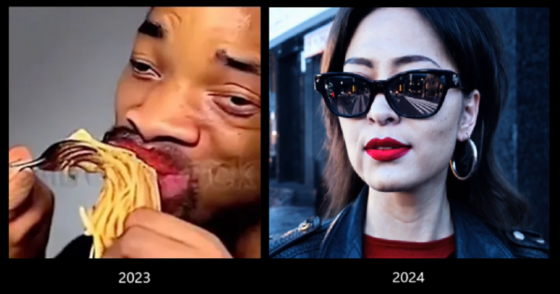
In March 2023, a reddit user shared an AI-generated video of American Actor Willl Smith eating spaghetti on the /rStableDifussion subreddit. This AI-generated content was reportedly made using an open-source tool called ModelScope, which is a text-to-video “diffusion model” that analyzes numerous photos and video from various data sets, including Shutterstock.
In February 2024, AI research company OpenAI announced their new text-to-video AI model system known as SORA, showcasing several high-quality sample outputs. Open AI noted that access to SORA is limited and currently available to only a few “Red Team” groups to assess the security risks associated with it, as well as some groups in the creative field.
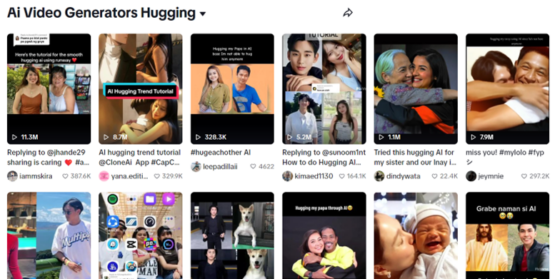
Later this year, a new trend on Tiktok and other social media platforms stormed the internet: AI hugging videos. These videos are created using AI tools that combine static photos of people or animals (and in some instance, cartoon or anime characters) recreating a virtual hug that is made to look almost real. These videos are generated using various tools online that are readily available to the public. There is currently a growing trend of online users utilizing this technology and posting their contents on various social media sites.
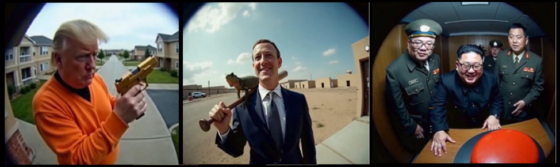
On August 28, 2024, The Dor Brothers, an AI video production studio released an “unhinged and satirical” realistic AI video on their X (formerly Twitter) account. The video showcased several high-profile individuals, including former United States (US) President Donald Trump, North Korean leader Kim Jong-un, and Facebook Chief Executive Officer (CEO) Mark Zuckerburg, among others. Using “uncensored AI generators”, they were able to create a manipulated video portraying the individuals in exaggerated scenarios, such as holding guns.
“Rather than censoring AI tools, we advocate for public access, empowering people to explore new possibilities. This ensures that society, not just big companies and governments, decides democratically what regulations and standards are right for our future.”
-Dor Brothers
Documented use of Deepfakes to Spread Misinformation and Disinformation
The use of deepfakes to spread misinformation and disinformation has already been documented in the Philippines:
CNN Anchor Ruth Cabal Investment Deepfake
On December 24, 2023, then CNN Philippines news anchor Ruth Cabal became a victim of a deepfake video that showed her talking about an investment platform that was allegedly announced by a certain Robin Padilla. She added that the video was taken from a previous newscast and contained manipulated audio, urging viewers to invest in a fraudulent platform.
Audio Deepfake of President Marcos Jr. Ordering Military Action Against China
On April 23, 2024, the Presidential Communications Office (PCO) released a statement, warning the public about a circulating video containing altered audio of President Marcos Jr., allegedly ordering military action against China in the event of military escalations. The PCO clarified that “no such directives” were given by the President and that the video contained manipulated audio generated using AI. The video was later taken down per request of the Department of Communications and Information Technology (DICT). However, copies of the video continue to circulate online.
AI images of Taylor Swift Falsely Endorsing US Politicians
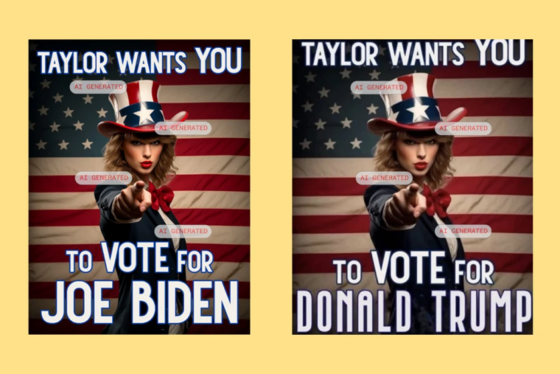
AI-generated images of American singer Taylor Swift endorsing US politicians circulated online. The image was reportedly generated in December 2023 in support of current US President Joe Biden and shared across several pro-Biden Facebook groups. On August 17, 2024, the same image was posted on X (formerly Twitter) with altered text in support of former US President Donald Trump, which was later shared by Trump himself on his Truth social account.
The creator of the AI image, who is an artist, stated that the image, which he posted on his public Facebook group was to help “boost support for Joe Biden because his communication was poor and his polls were low and Trump was a looming threat and I just couldn’t stand idly by.”
AI Regulation?
At the time of writing, the Philippines does not have a law specifically regulating the use of AI. While some existing laws, such as the Data Privacy Act of 2012 and the Cybercrime Prevention Act of 2012, cover some aspects of its use, these are often insufficient to cover the entirety of AI activities.
Pending bills on AI:
- House Bill No. 7396 – Artificial Intelligence Development and Regulation Act of the Philippines (Filed March 1, 2023, and pending first reading since January 1, 2024)
- House Bill No. 9448 – Protection of Labor Against Artificial Intelligence Automation Act (Filed November 7, 2023, and pending with the Information and Communications Technology in first reading since November 13, 2023)
- House Bill No. 7913 – Artificial Intelligence Regulation Act (Filed May 2, 2023, and pending with the Information and Communications Technology since January 31, 2024)
- House Bill No. 9425 – Penalizing Deepfake Act (Filed October 25, 2023, and pending with the Committee on Information and Communications Technology since November 8, 2023)
- House Bill 10567 – Deepfake Accountability and Transparency Act (Filed July 1, 2024, and pending with the Committee on Information and Communications Technology since July 29, 2024)
In any circumstance, it could be challenging to enforce these regulations against powerful politicians in the Philippines.
Public Accessibility to Deepfake Creation and its Limitations
PSA notes that the means to create audio and certain video deepfakes are now accessible to the public through various software and tools available online. Some audio deepfake software is free to use but comes with limited features. Paid models on the other hand, offer more functionalities, such as being able to take a voice sample and clone it to say anything. On the other hand, customized video deepfakes, such as ones produced by the Dor Brothers, require more time, resources, and knowledge to produce.
This level of video manipulation is not yet generally accessible to the public, as video deepfake creation is more complex than audio deepfakes. However, recent developments in AI technology have not only enabled the creation of more realistic outputs but also increased accessibility to the public, opening both new possibilities and certain risks.