
Philippines’ Year-On-Year GDP Growth Rate Accelerates to 6.3 Percent in the Second Quarter of 2024
August 20, 2024
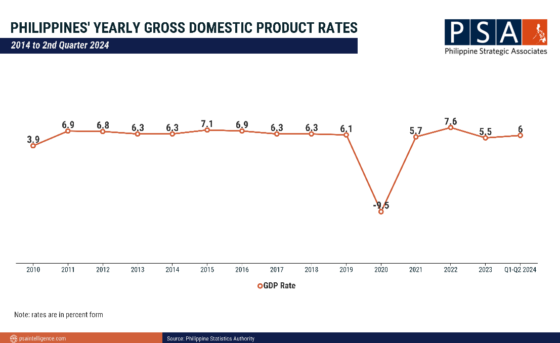
The Philippines’ year-on-year economic growth accelerated to 6.3 percent in the second quarter of 2024, the Philippine Statistics Authority (PSA) reported last Thursday, August 8. The government remained optimistic of achieving its 6-to-7 percent growth target for the year, but economists and analysts noted that high inflation and weak household consumption may temper economic growth in the short term.
Faster GDP Growth Observed in Second Quarter
The recorded gross domestic product (GDP) growth in the second quarter of 2024 exceeded the 5.8 percent recorded growth in the previous quarter and the 4.3 percent in the second quarter of 2023. This is also the highest expansion of GDP since the 6.4 percent recorded in the first quarter of 2023. The economic growth recorded in the second quarter places the country’s overall GDP growth for 2024 well within the government’s target growth rate of 6 to 7 percent.
Major contributors to second quarter growth include the construction sector (16 percent) and financial and insurance activities sector (8.2 percent). Meanwhile, the sectors of wholesale and retail trade and motorcycle/vehicle repair recorded a combined 5.8 percent.
Across major economic sectors, only agriculture, forestry, and fishing experienced a decline (-2.3 percent), attributed to prevailing seasonal conditions such as the El Niño phenomenon.
Year-On-Year Growth Driven By Construction, While Household Spending Weakens
National Economic and Development Authority (NEDA) Secretary Arsenio Balisacan attributed the year-on-year GDP growth to an increase in total investments, largely driven by robust construction activities. Increased public spending also contributed to this growth as government infrastructure and rehabilitation projects expanded by 21 percent in the second quarter, faster than the 12.1 percent growth last year.
Secretary Balisacan noted that the Philippines’ second-quarter economic growth positioned the country as “one of Asia’s best-performing major emerging economies,” surpassing Malaysia (5.8 percent), Indonesia (5 percent), and China (4.7 percent) during the same period. However, the secretary recognized that the growth could have been more impactful for Filipinos if not for accelerating inflation and high interest rates. The continuing impact of inflation was evidenced by the year-on-year decline in household spending, posting a 4.6 percent growth in the second quarter of 2024 against a 5.5 percent growth in the same period last year.
Experts Downgrade GDP Growth Forecast
Meanwhile, research and risk consultancy firm BMI Research downgraded its 2024 Philippine economic growth outlook to 6 percent from its initial projection of 6.2 percent. According to BMI Research, the reported 6.3% growth in the second quarter painted a “misleading picture” of the economy, as the latest growth in the April-June period was likely influenced more by base effects and less by actual economic expansion. The firm added that for the Philippines to achieve the former projection of 6.2 percent, it would have to achieve a growth of 6.4 percent for the last six months of the year, which would be “unlikely.”
Other economists shared similar sentiments, noting that GDP growth for the rest of 2024 may not be enough to help the government meet its 6-to-7-percent target for the year. Weak household consumption is expected to persist until the end of the year in light of high inflation.
Nonetheless, Secretary Balisacan assured that the government is committed to ensuring continued economic growth in the coming months, largely by tempering food inflation and keeping interest rates manageable to propel household consumption and investment activities.