A New Flashpoint Emerges in the West Philippine Sea as China and the Philippines Collide at Escoda Shoal
August 20, 2024
The Philippines and China clashed anew off the waters of Palawan this week, further sparking concerns about the development of a new flashpoint in the West Philippine Sea, this time around Escoda (Sabina) Shoal.
Largest structural damage so far – PCG
On Monday, August 19, two Philippine Coast Guard (PCG) vessels “encountered unlawful and aggressive maneuvers” from two other Chinese Coast Guard (CCG) vessels on their way to the islands of Patag and Lawak in the West Philippine Sea. According to reports from the PCG, the first incident took place at 3:24AM when the Philippines’ BRP Cape Engaño collided with CCGV-3104 around 23 nautical miles from Escoda (Sabina) Shoal. Another incident occurred shortly after, when CCGV-21551 rammed BRP Bagacay twice on its port and starboard sides, also near the same shoal. Both PCG vessels sustained minor structural damage and no casualties were reported in the incident.
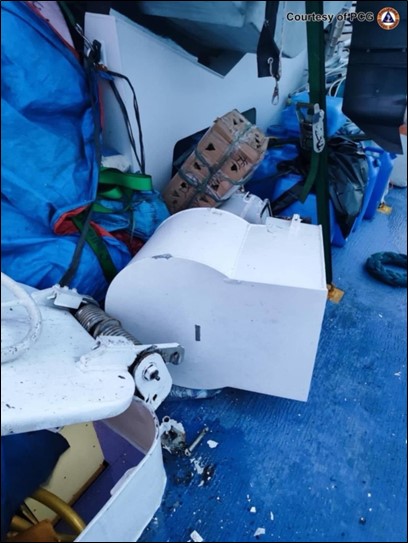
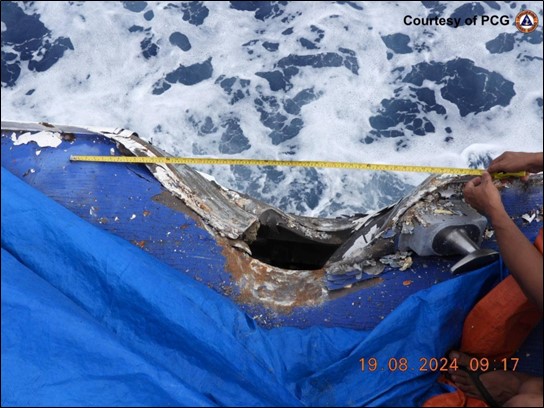
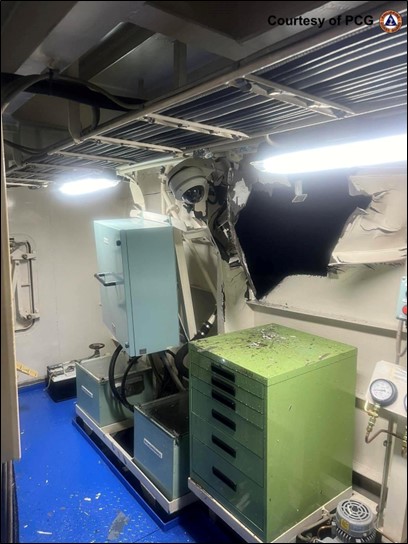
Damage sustained by BRP Bagacay and BRP Cape Engaño. Source: Philippine Coast Guard (1)(2)
Patag and Lawak Islands are both part of the disputed Spratly Group of Islands, which all lie within the Philippines’ 200-nautical-mile exclusive economic zone and are administratively overseen by the municipality of Kalayaan in Palawan province. The Philippines has occupied Lawak Island since 1968 and monitors Patag Island from an outpost on Lawak – the PCG vessels were en route to the islands on Monday to deliver supplies for soldiers stationed in the area. Meanwhile, Escoda Shoal, where the incident took place, is 75 nautical miles (approximately 140 kilometers) away from the coast of Palawan and about 67.3 kilometers away from Ayungin (Second Thomas) Shoal.
PCG Spokesperson Commodore Jay Tarriela reported that the recent damage sustained by the PCG ships in the incident was the worst they had seen so far. “We can fairly say that this is the biggest structural damage we have incurred as a result of the dangerous maneuver of the Chinese Coast Guard,” Commodore Tarriela stated. This was also reportedly the first time that the CCG had encountered the PCG during a resupply mission to Patag and Lawak Islands. Commodore Tarriela later noted that the CCG vessels eventually left the PCG alone after confirming that the fleet was not headed for Escoda Shoal specifically.
Goodbye Ayungin, Hello Escoda
China was the first to publicly report the incident on Monday. CCG Spokesperson Gan Yu reported via Chinese social media that the PCG had “illegally entered” the vicinity of Escoda Shoal, claiming that BRP Bagacay “deliberately” collided with the CCG’s vessels. The CCG went on to blame the Philippines for the incident and demanded that it stop its actions in the shoal, “otherwise all the consequences arising therefrom will be borne by the Philippines.”
The PCG had deployed its largest vessel BRP Teresa Magbanua to the shoal last April following local scientists’ reports of Chinese reclamation in the area. China responded with a diplomatic protest lodged last week – at the time, China alleged that the Philippines was planning to send another ship to Escoda as support for BRP Teresa Magbanua, something they described as “an attempt to construct a forward deployment base in the form of a semi-permanent floating platform.” The Chinese Ministry of Foreign Affairs then warned of “resolute measures” to guard the shoal, which it also claims as its own, should the Philippines push through with its plans.
The PCG refuted China’s claims, which they argued “stem from their own pattern of unlawful occupation of maritime areas in the South China Sea.” Commodore Tarriela then stated yesterday that the incident on Monday was likely driven by China’s “paranoia” over what the Philippines might do in Escoda Shoal.
Geopolitical analysts and observers have raised concerns over Escoda Shoal becoming the new flashpoint of Philippine and Chinese relations in the West Philippine Sea. Following the relative peace currently observed in Ayungin Shoal, it appears that China may be shifting its attention and resources towards other areas in the West Philippine Sea – Monday’s incident in Escoda occurred less than two weeks after the encounter between Chinese and Philippine aircraft over Bajo de Masinloc (Scarborough Shoal).
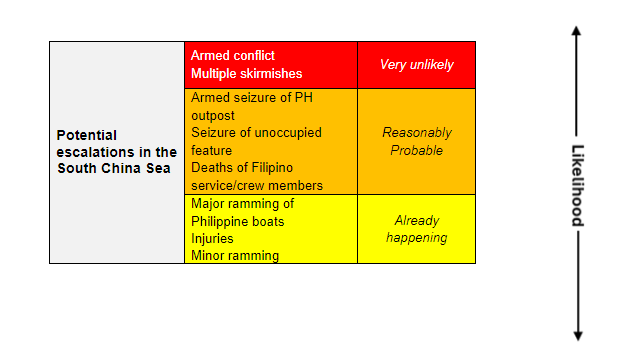
PSA analysts continue to maintain that while the Philippines and China are locked in a long-term contest for sovereignty over the West Philippine Sea, we do not see a significant risk of war or serious armed conflict. PSA continues to assess that the Philippines and China will work to find ways to de-escalate after particularly concerning incidents, such as the clash in June which resulted in serious injuries to a Philippine Navy sailor. There is a real risk of loss of life of Philippine personnel in these clashes, which would cross President Ferdinand Marcos Jr.’s threshold for the activation of the Mutual Defense Treaty with the United States.
Nonetheless, the activation of the Mutual Defense Treaty does not guarantee war, and even in the case of its activation, the Philippine and United States governments are likely to work to craft a joint policy response designed to lower the risk of war. Meanwhile, the Philippines will be locked in a contest with China, which will be a test of political will, logistics, positioning, and occasionally, blood.